Lake Michigan Atmospheric Dynamics: Lake-Effect Snow Belts & Severe Roof Failures
Situated approximately thirty miles east of Lake Michigan, Grand Rapids occupies a prominent position in West Michigan's notorious snow belt. Winter weather systems traversing the relatively warm, open waters of Lake Michigan absorb massive amounts of moisture and latent heat. As these saturated westerly air masses make landfall and encounter the higher topography of the Grand River Valley and Kent County glacial ridges, they undergo rapid orographic lifting and condensation, precipitating intense, localized lake-effect snow squalls that regularly deposit sixty to eighty inches of dense, water-heavy snowpack per season.
These intense meteorological dynamics subject residential and commercial roofing envelopes across Grand Rapids, Kentwood, Wyoming, and Forest Hills to structural loads far exceeding typical Midwest baselines. When heavy snow blankets a roof deck, residential architectural heat loss quickly transforms the thermal balance. Warm air escaping through unsealed attic bypasses, uninsulated can lights, and inadequate R-value insulation (frequently under R-30 in pre-1980 housing stock) warms the roof sheathing above 32°F (0°C). This thermal gradient causes the bottom layer of snow to melt, producing a continuous stream of meltwater running down the roof plane beneath the insulating snow blanket.
Once this meltwater reaches the unheated roof eaves, gutters, and overhangs—which remain at sub-freezing ambient outdoor temperatures—it rapidly refreezes. Over forty-eight to seventy-two hours of cyclical freezing and thawing, this process builds an impermeable ridge of solid ice known as an ice dam. As subsequent meltwater pools behind this frozen barrier, it has nowhere to drain. Trapped hydrostatic head pressure forces water backward and upward under the overlapping tabs of asphalt shingles, saturating standard asphalt-saturated organic felt underlayment and penetrating through plywood or oriented strand board (OSB) seams into structural attic trusses, wet-blown cellulose insulation, and ceiling drywall.
The Lake Michigan Gale Stressor: High-Velocity Straight-Line Shearing
In addition to heavy snowpack, Grand Rapids frequently experiences winter and spring gale squalls with straight-line gusts reaching 55 to 65+ miles per hour sweeping across the flat West Michigan terrain. Cold-embrittled asphalt fiberglass shingles lose their adhesive sealant strip elasticity in freezing weather, allowing high winds to lift, crease, and shear tabs clean off the fastener line. Once shingles are detached, driving precipitation immediately saturates unprotected wooden roof sheathing, requiring instant 24/7 tarping stabilization.
When structural integrity is compromised during a winter storm, property owners cannot afford to submit web contact forms and wait days for a response. Roof Expert USA maintains direct, immediate contractor dispatch throughout Kent County, deploying emergency technicians equipped with specialized commercial steam extraction equipment and heavy-duty 10-mil poly tarps to arrest active leaks before ceiling collapse or toxic black mold proliferation occurs.
Technical System Restoration: Shingle, Low-Slope, Chimney Flashing & Valleys
The architectural landscape of Greater Grand Rapids encompasses historic Victorian and Craftsman residences in Heritage Hill, mid-century ranch homes in Wyoming, expansive multi-gable contemporary estates in Forest Hills, and sprawling commercial industrial parks in Walker. Each building era and architectural typology requires specialized emergency engineering:
1. Heavy Architectural Fiberglass Asphalt Shingle Systems
Under Michigan Residential Code (MRC) Chapter 9 (Roof Assemblies), asphalt shingles in West Michigan high-wind exposure zones must comply with ASTM D3161 Class F (110 mph wind resistance) or ASTM D7158 Class H (150 mph wind resistance). Following winter gale blow-offs or ice dam tears, dispatched crews inspect the underlying deck for rot, replace waterlogged sheathing with exterior-grade APA-rated plywood, and install self-adhering polymer-modified bitumen underlayment (ASTM D1970) extending a minimum of 24 inches inside the interior warm wall line. Shingle rows are fastened with corrosion-resistant hot-dipped galvanized roofing nails utilizing an enhanced 6-nail per shingle pattern.
2. Historic Masonry Chimney Step Flashing & Valley Seals
Historic Grand Rapids brick homes frequently experience severe chimney leaks where the chimney intersects the roof slope. Freeze-thaw cycling in Kent County causes mortar joints to crumble and step flashing to detach. Emergency repair protocol involves cutting a clean reglet groove into the brick mortar line, installing heavy-gauge L-shaped step flashing interlaced with each shingle course, and seating a continuous counter-flashing bib sealed with elastomeric polyurethane expansion caulk. Valleys are stabilized using ice-and-water membranes topped with 26-gauge W-valley metal flashings to channel melting lake snow safely into downspouts.
3. Commercial Flat & Low-Slope Systems (EPDM, TPO & Mod-Bit)
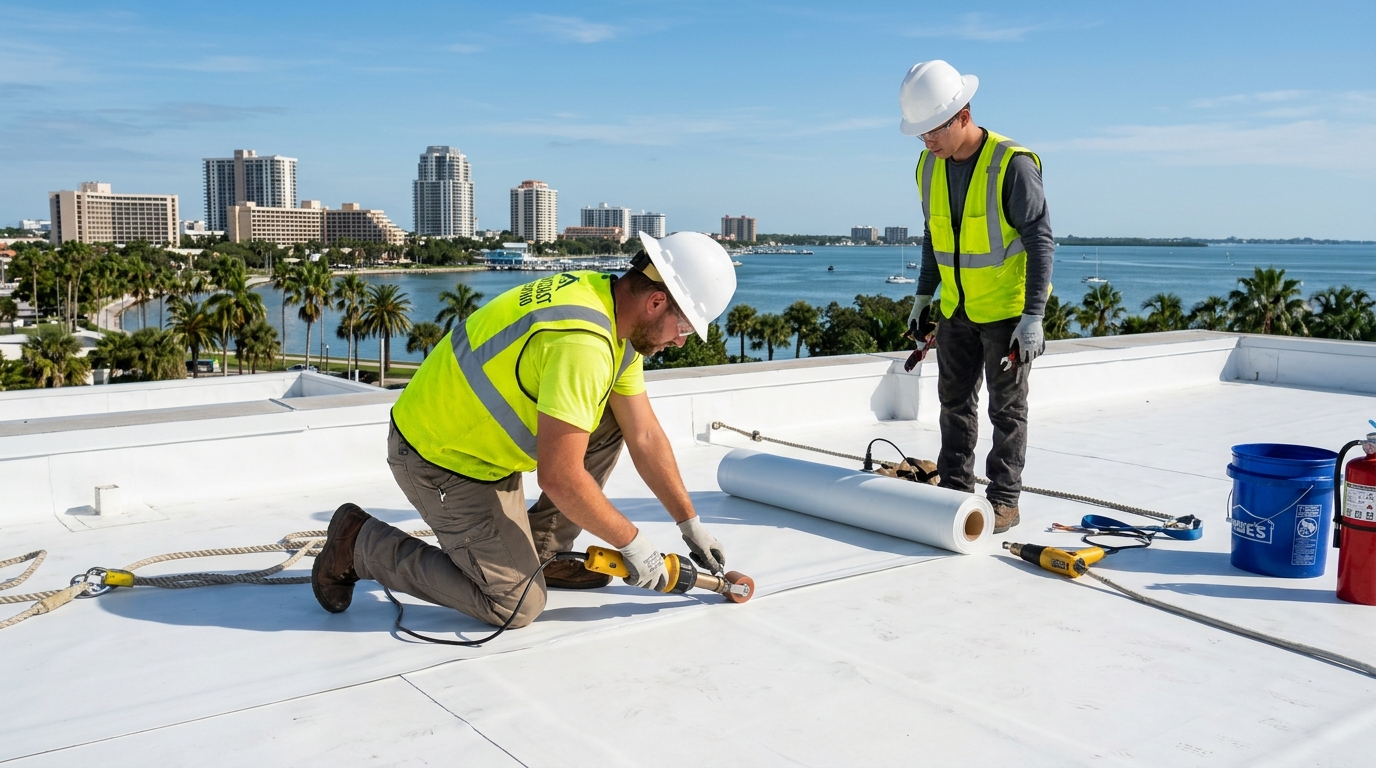
Commercial properties throughout Walker, Grandville, and Wyoming feature low-slope roofs vulnerable to severe snow accumulation and internal drain freeze-ups. Dispatched commercial crews utilize high-frequency moisture scanners to trace ponding intrusion beneath ballast rock, re-weld separated TPO seams with hot-air robotic welders, and apply emergency elastomeric mastic patches over punctured EPDM rubber membranes to stop water intrusion into commercial facilities.
Frequently Asked Questions: Grand Rapids Emergency Roofing
How quickly can an emergency roofing crew arrive at my Grand Rapids home?
Our dispatch system targets crew arrival within 45 to 90 minutes throughout Grand Rapids, Kentwood, Wyoming, Forest Hills, and Walker. During major Lake Michigan lake-effect blizzards, priority is allocated based on active structural inundation, ceiling deflection, and proximity to major Kent County thoroughfares (US-131, I-196, and I-96).
Why do you use steam instead of axes or hammers to remove ice dams?
Using axes, ice picks, or shovels on a frozen roof shatters brittle asphalt shingles, rips protective ceramic granules, and punctures underlying plywood decking, causing catastrophic secondary leaks and completely voiding manufacturer warranties. Commercial low-pressure steam cuts through ice dams smoothly using heat rather than mechanical force, preserving the roof envelope beneath.
Will my homeowner's insurance policy cover emergency tarping in Grand Rapids?
Yes. Under virtually all standard Michigan homeowner policies, property owners are contractually obligated to mitigate ongoing water intrusion to prevent secondary damages like drywall collapse and black mold growth. Emergency tarping, shrink-wrapping, and temporary leak containment costs are typically fully reimbursable under the loss mitigation section of covered storm damage claims.
Why is there no online contact form on this website?
Active water intrusion requires instantaneous technical triage. Online web contact forms frequently sit in unmonitored queues for hours while active leaks destroy hardwood flooring, ceiling joists, and electrical fixtures. Our direct telephone hotline at (888) 208-4155 connects you immediately with live dispatchers who assess leak severity and mobilize emergency crews without delay.
Are dispatched roofing contractors licensed and insured in Michigan?
Yes. All independent roofing contractors dispatched through Roof Expert USA hold active Michigan Department of Licensing and Regulatory Affairs (LARA) Residential Builder or Maintenance & Alteration Contractor licenses, carry at least ,000,000 in commercial general liability insurance, and maintain full statutory worker's compensation coverage.
What should I do inside my house while waiting for the emergency crew to arrive?
Immediately place plastic buckets beneath active drips. If water is bubbling beneath ceiling paint, carefully relieve hydraulic pressure by puncturing the center with a small nail to prevent widespread ceiling sheetrock collapse. Move electronic equipment and valuable furniture out of the room, and switch off circuit breakers to damp lighting fixtures. Never attempt to climb onto a snowy, icy, or wind-damaged roof yourself.